
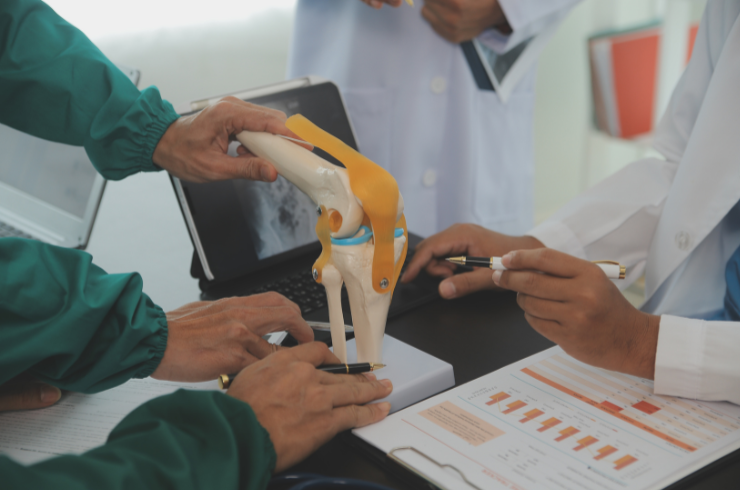
Ligament reconstruction is a surgical procedure used to restore stability to a joint when a ligament has been severely damaged or torn and is unlikely to heal adequately on its own.
Ligaments connect bones and help control the movement and stability of a joint. A significant ligament injury can result in pain, swelling, weakness, or a feeling that the joint is giving way during everyday activities or sports.
During reconstruction, the damaged ligament is replaced or restored using a suitable graft or reconstruction technique. The specific approach depends on the ligament involved, the extent of the injury, and the patient’s functional requirements.
Not every ligament injury requires surgery. Some partial tears and less severe injuries may respond well to structured rehabilitation and activity modification.
Ligament reconstruction may be considered when:
A detailed assessment helps determine whether reconstruction is appropriate.
Ligament reconstruction can be performed for different joints and injuries. Common examples include:
An anterior cruciate ligament (ACL) injury is a common cause of knee instability, particularly among athletes and physically active individuals. Reconstruction may be considered when significant instability persists or when the patient wishes to return to activities involving pivoting and rapid changes in direction.
The posterior cruciate ligament (PCL) helps control backward movement of the shin bone relative to the thigh bone. Significant PCL injuries may require reconstruction when instability persists despite appropriate non-surgical treatment.
Some injuries involving the medial collateral ligament (MCL) and other supporting knee ligaments can result in persistent instability. Treatment depends on the severity and location of the injury and whether other structures have also been damaged.
Diagnosis begins with a detailed discussion about how the injury occurred, the symptoms that followed, and any previous episodes of instability.
During the examination, the affected joint may be assessed for:
Imaging such as X-rays or MRI may be recommended when required to assess the ligament and identify associated injuries.
An MRI can provide detailed information about soft-tissue structures within and around a joint. It may help identify ligament tears and associated injuries involving cartilage, menisci, tendons, or other structures.
However, imaging findings are considered alongside the patient’s symptoms and physical examination when deciding on treatment.
The surgical technique depends on the ligament being reconstructed and the extent of the injury.
In many procedures, the damaged ligament is reconstructed using a suitable graft. The graft is positioned and secured to restore the appropriate stability and movement of the joint.
Arthroscopic techniques may be used for certain ligament reconstruction procedures, allowing the surgeon to assess and treat internal joint structures through small incisions.
The exact surgical approach is planned according to the patient’s anatomy, injury pattern, activity requirements, and associated joint damage.
Depending on the ligament and surgical procedure, reconstruction may involve different types of grafts.
Grafts can be obtained from the patient’s own tissue or, in selected situations, from donor tissue. The choice depends on several factors, including the ligament being reconstructed, patient characteristics, activity level, and surgical requirements.
Your surgeon can explain the most appropriate graft option for your specific injury.
Before surgery, the joint is evaluated to understand the extent of instability and any associated injuries. The treatment plan may include imaging, assessment of muscle strength and movement, and discussion of the patient’s activity or sporting goals.
In some cases, physiotherapy may be recommended before surgery to improve joint movement and muscle control. This can help prepare the joint for the rehabilitation process following reconstruction.
Recovery after ligament reconstruction takes place in stages. The early period focuses on protecting the reconstructed ligament while gradually restoring safe movement.
As healing progresses, rehabilitation generally focuses on:
The rehabilitation programme and progression depend on the ligament reconstructed and the individual patient’s recovery.
There is no single recovery timeline for every ligament reconstruction. The duration depends on the ligament involved, the surgical technique, associated injuries, physical condition, and rehabilitation progress.
Patients may return to everyday activities before they are ready for high-impact or pivoting sports. A gradual progression is generally required before returning to demanding physical activities.
Your surgeon and physiotherapist can provide guidance based on your procedure and recovery milestones.
Rehabilitation is an essential part of the recovery process. Simply completing the surgery does not restore full joint function; the reconstructed ligament needs appropriate protection and the surrounding muscles need to regain strength and control.
A structured rehabilitation programme may progress from basic movement and muscle activation to strengthening, balance exercises, functional movements, and sport-specific training when appropriate.
Following rehabilitation recommendations can help support a safe and progressive return to activity.
Athletes often want to know when they can return to training and competition following reconstruction. The answer depends on the type of injury, procedure, healing, strength, joint stability, and functional recovery.
Before returning to high-demand sports, patients may need to demonstrate appropriate strength, movement control, balance, and functional ability. Return to sport should be based on recovery milestones rather than a fixed date alone.
The consequences of an untreated ligament injury depend on the ligament involved and the severity of the tear.
Persistent instability can interfere with daily activities and sports. Repeated episodes of giving way may also place additional stress on other structures within the joint.
A specialist assessment can help determine whether rehabilitation alone is appropriate or whether surgical reconstruction should be considered.
Ligament repair and reconstruction are not the same procedure.
Ligament repair involves attempting to preserve and repair the patient’s existing ligament when the injury pattern and tissue quality make this appropriate.
Ligament reconstruction involves restoring the ligament using a graft or other reconstruction technique when the original ligament cannot provide adequate stability.
The appropriate approach depends on the type and location of the injury, tissue quality, and individual patient factors.
Your injury, symptoms, activity level, and joint stability are evaluated.
Appropriate imaging may be used to assess the ligament and identify associated injuries.
The options for rehabilitation or surgery are discussed based on the severity of the injury and your functional requirements.
When surgery is indicated, the damaged ligament is reconstructed using an appropriate technique and graft.
The reconstructed ligament is protected while movement and muscle activation are gradually restored.
Strength, balance, coordination, and joint control are progressively developed.
Daily activities, work, exercise, and sports are gradually reintroduced according to individual recovery milestones.
Expert Surgical Repair for ACL, PCL & Rotator Cuff Tears
Ligament injuries are common in athletes and active individuals. Dr. Mudit Nemani specialises in reconstructive surgeries that restore knee and shoulder stability.
ACL tears
PCL injuries
Rotator cuff tears
Shoulder instability
Multi-ligament injuries
Minimally invasive arthroscopic reconstruction
Precision graft selection
Secure fixation for long-term stability
Customised rehabilitation roadmap
Restores joint stability
Prevents ongoing damage
Improves athletic performance
Reduces risk of future injuries
Ligament reconstruction is a surgical procedure used to restore joint stability when a damaged ligament cannot adequately perform its normal function.
No. Some ligament injuries can be managed with physiotherapy, activity modification, and other non-surgical treatments. Reconstruction may be considered when significant instability persists or when the injury requires surgical treatment.
Diagnosis generally involves a physical examination and assessment of the injury mechanism and symptoms. X-rays or MRI may be recommended when additional information is required.
Recovery varies depending on the ligament involved, surgical technique, associated injuries, and rehabilitation progress. Returning to high-demand sports generally takes longer than returning to basic daily activities.
Yes, rehabilitation is an important component of recovery. Physiotherapy helps progressively restore movement, strength, stability, coordination, and functional ability.
Many patients can work towards returning to sports after appropriate recovery and rehabilitation. The timing depends on the reconstructed ligament and whether strength, stability, and functional milestones have been achieved.
Some ligament injuries can improve without surgery, particularly when the tear is partial or the joint remains stable. The appropriate treatment depends on the specific ligament, severity of injury, and individual requirements.
A ligament injury can affect joint stability long after the initial pain and swelling have settled. Persistent giving-way, instability, or difficulty returning to physical activity may require further evaluation.
Dr. Mudit Nemani can assess the extent of your ligament injury, evaluate joint stability, and recommend an appropriate treatment and rehabilitation plan based on your individual needs.
 +91-8961265236
 nemani.mudit@gmail.com
 Bidhannagar, Kolkata, West Bengal