
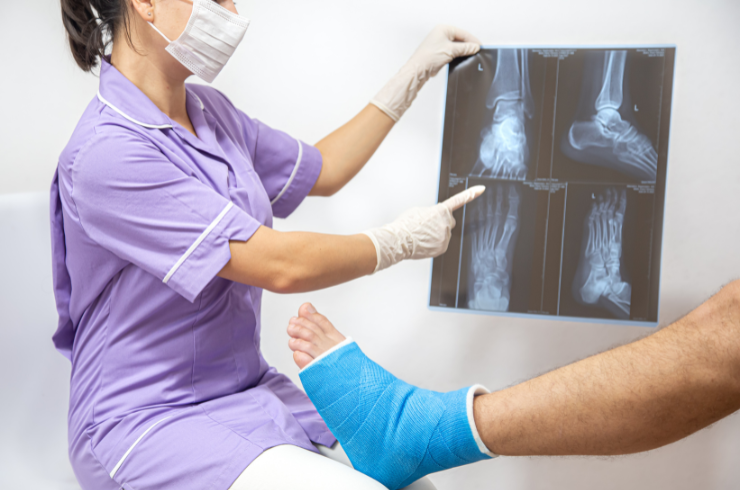
Fracture and trauma surgery involves the assessment and surgical treatment of broken bones and complex musculoskeletal injuries caused by accidents, falls, sports injuries, or other forms of trauma.
While some fractures can heal with immobilisation or other non-surgical treatment, displaced, unstable, open, or complex fractures may require surgery to restore bone alignment and provide adequate stability for healing.
The treatment approach depends on the location and severity of the fracture, the condition of surrounding soft tissues, and the patient’s overall health.
Not every fracture requires an operation. The appropriate treatment depends on factors such as the type of fracture, bone alignment, stability, and involvement of a nearby joint.
Surgical treatment may be considered when:
A detailed evaluation helps determine whether surgical fixation is appropriate.
Some traumatic injuries require prompt medical assessment. Severe pain, visible deformity, significant swelling, an open wound near a suspected fracture, or difficulty moving or bearing weight can indicate a more serious injury.
After an accident or fall, the affected limb should be protected from unnecessary movement until it can be properly assessed. Further examination and imaging may be required to understand the extent of the injury.
Diagnosis begins with a physical examination and assessment of how the injury occurred. The affected area is evaluated for pain, swelling, deformity, movement, and other signs of injury.
X-rays are commonly used to identify the location, pattern, and alignment of a fracture.
A CT scan may be recommended for complex fractures, particularly when detailed information about the bone or joint surface is required for surgical planning.
Additional imaging may be considered when soft-tissue damage or another associated injury is suspected.
The choice of investigation depends on the nature and severity of the injury.
The surgical technique depends on the type and location of the fracture.
After the fracture has been assessed, the bone fragments are carefully repositioned to restore appropriate alignment. Internal fixation may then be used to maintain stability while the bone heals.
Depending on the injury, fixation can involve:
The surgical plan is individualised according to the fracture pattern, bone quality, surrounding tissues, and functional requirements of the patient.
A closed fracture occurs when the broken bone does not create an open wound communicating with the outside environment. Treatment depends on the fracture’s alignment and stability.
An open fracture occurs when the fracture is associated with an open wound. These injuries require particularly careful assessment because of the risk of contamination, infection, and soft-tissue damage.
Treatment may involve urgent surgical management, cleaning of the wound, fracture stabilization, and appropriate wound care.
Some fractures extend into the surface of a joint. These injuries require careful assessment because improper alignment can affect joint movement and may contribute to stiffness or other long-term problems.
When surgery is required, restoring appropriate alignment and stability of the joint surface becomes an important part of treatment.
Recovery after fracture and trauma surgery depends on the type of fracture, surgical procedure, bone involved, overall health, and progress of healing.
Early recovery may focus on:
As healing progresses, rehabilitation can be adjusted to improve mobility, strength, balance, and functional movement.
Rehabilitation is an important part of recovery following fracture fixation. The programme is tailored according to the injury and the stability achieved during surgery.
Depending on the fracture, rehabilitation may include:
The timing of each stage should be guided by the treating team and the progress of bone healing.
There is no single healing timeline for every fracture. Bone healing depends on factors including the location and severity of the fracture, the patient’s age and general health, bone quality, blood supply, and whether complications occur.
Some patients may resume certain activities relatively early, while more complex fractures require a longer period of protection and rehabilitation.
Follow-up assessments and appropriate imaging may be used to monitor healing and guide progression of activity.
In some cases, a fracture may heal slowly or fail to unite as expected. Other problems can include malalignment, persistent pain, stiffness, or reduced function.
These situations require further evaluation to identify the reason for delayed or abnormal healing and determine whether additional treatment is necessary.
Following a fracture, prolonged immobilisation can affect muscle strength and joint mobility. Once it is safe to do so, appropriate movement and rehabilitation can help restore function.
The rehabilitation programme should be progressed according to the stability of the fracture and the stage of healing rather than following a fixed timeline for every patient.
The timing of return to work depends on the injured bone, type of treatment, physical demands of the job, and progress of healing.
Patients with physically demanding occupations may require a longer period before returning to lifting, prolonged standing, climbing, or other strenuous activities. A gradual return may be recommended when appropriate.
Athletes may require additional rehabilitation before returning to training and competitive sports. Strength, mobility, balance, coordination, and sport-specific movement should be assessed before progressing to higher levels of activity.
The return-to-sport timeline varies significantly depending on the injury and procedure performed.
The injury, symptoms, mechanism of trauma, and overall condition are assessed.
X-rays or other appropriate imaging help determine the type and severity of the fracture.
The fracture is evaluated to determine whether non-surgical management or surgical fixation is more appropriate.
When surgery is required, the bone is aligned and stabilized using an appropriate fixation technique.
Pain management, protection of the injured area, and appropriate movement are introduced.
Strength, mobility, balance, and functional activity are progressively restored.
Regular assessment helps monitor healing and determine when activities can safely be increased.
Precision-Based Bone Fixation & Alignment Care
Fractures require timely and expert care for proper healing. Dr. Mudit Nemani offers trauma surgery using modern fixation systems for fractures of the limbs, joints, and complex injuries.
Simple fractures
Compound (open) fractures
Joint fractures
Multi-fragment fractures
Trauma from accidents or falls
Alignment restoration
Metal plates, screws, or rods for stability
Soft-tissue protection
Early mobilization plan
Stable bone healing
Reduced pain
Return to daily function quickly
Prevent long-term deformity or stiffness
Dr. Nemani applies precision, modern techniques, and personalised rehabilitation guidance for complete recovery.
Fracture and trauma surgery involves the surgical treatment of broken bones and complex musculoskeletal injuries when restoring alignment and stability requires an operative approach.
No. Many fractures can be treated without surgery. An operation may be recommended when a fracture is displaced, unstable, complex, involves a joint, or cannot be adequately managed through conservative treatment.
A clinical examination and X-rays are commonly used to diagnose fractures. CT scans or other imaging may be recommended for complex injuries or when additional detail is needed.
Recovery varies depending on the fracture, surgical procedure, bone involved, overall health, and rehabilitation progress. More complex injuries generally require a longer recovery period.
Rehabilitation is commonly an important part of recovery. Depending on the injury, physiotherapy may help restore movement, strength, balance, and functional ability.
Whether and when you can put weight on the affected limb depends on the fracture and the stability achieved through treatment. Your surgeon will provide specific weight-bearing instructions.
Yes. Fractures involving or close to a joint may sometimes lead to stiffness or restricted movement. Appropriate treatment and rehabilitation can help restore function where possible.
An orthopaedic assessment may be appropriate when a fracture is displaced, unstable, complex, associated with significant soft-tissue injury, or when symptoms or function do not improve as expected.
A fracture can affect more than the bone itself. Appropriate assessment and treatment are important for restoring alignment, stability, movement, and function.
If you have sustained a significant fracture or traumatic orthopaedic injury, Dr. Mudit Nemani can assess the injury and recommend an appropriate treatment approach based on the type and severity of the fracture.
 +91-8961265236
 nemani.mudit@gmail.com
 Bidhannagar, Kolkata, West Bengal